

It’s been a few months since I gave you an update on this project. Bottom line: I’ve been writing the book that this newsletter has helped me research. I spent much of July drafting chapters for Along The Ohio: Stories the River Still Carries, and then a week at the Appalachian Writers Workshop studying with Charles Dodd White.
From there, I spent nearly a week in Indiana and Illinois. Boy, did I learn a lot.
When Madison was platted in 1809-1810 it filled the gap between two already-mature ports: Cincinnati upstream about 70 miles, and Louisville about 46 downstream. It became Indiana’s third-largest city and a major hog-processing/steamboat hub within a few decades.
Indiana is, of course a Midwestern state, and as part of the Northwest Territory, slavery was not permitted there. However, an old Ordinance signed and stored back east was secondary to the labor needs settlers faced on the frontier. Not only that, people were too busy scratching out a living than to fund territory-wide enforcement. These two factors combined to give Indiana’s southern counties a unique culture born of cross-river proximity to Kentucky, a slave state until 1865.
Today’s visitors see Madison’s charms through Victorian architecture, a vibrant riverfront, and a range of cute shops and upscale eateries, but the town embraces its divided Antebellum heritage too.


While our Hollywood-induced cultural memory is that planters lived on their plantations, that wasn’t the case here. Many of them lived in Madison — a proper river port with services and society — while holding the people they enslaved across the water in Kentucky. So “free Indiana” butting up against “slave Kentucky” wasn’t a clean line; slaveholders were commuting from Indiana to their own enslaved workforce every day, sometimes bringing workers along to help in the house and gardens in Madison, but sending them back across the river to prove that they weren’t really practicing slavery in a free state.
White family lines crossed that same slave-free boundary just as messily. Take Robert Right Rea, a slave catcher who was also, simultaneously, the sitting Jefferson County sheriff. He was the “major obstacle” faced by Underground Railroad conductor Robert Elliott, a teamster living about ten miles north of Madison. The twist: Rea was a cousin of Elliott’s own wife. So the two Jefferson County men working on opposite sides of the slavery laws that permitted enslavers to capture “fugitive slaves” even in free states were literally family. I can only imagine the frosty interactions around the extended family’s holiday dinner tables.
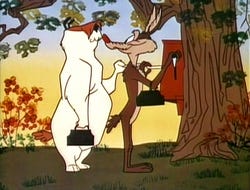
Reminds me of those Looney Tunes characters Sam Sheepdog and Ralph Wolf.
Sheriff Rea's double-identity as a slave catcher brought him into contact with a prominent abolitionist in Jefferson County, John H. Tibbets, who wrote in his own memoir that Rae (which he spelled Ray) "was known all over Kentucky and was always applied to when a slave got away."1 Later in Tibbets’ account he tells of an enslaved man in Kentucky who was trusted by his owner to conduct business on the Ohio side of the river. He never tried to escape. Unbeknownst to the enslaver, the worker was also helping fugitives make river crossings at night.
One evening, the sheriff caught the worker in the act and induced him to try running away with the group of fugitives so that Rae could “catch” all of them and collect a reward. This backfired when the old man’s enslaver said Rae had tricked his worker and therefore refused to pay the bounty.
A few years later, Rae turned up drowned in the Ohio River below Madison. The river that carried so many people to freedom on his watch, in the end, carried him too.
Information about abolitionists’ activities before the Civil War is particularly difficult to substantiate unless something they did involved legal procedures. UGRR conductors weren’t prone to keeping statistics and diaries of their work.


One reason people moved through this stretch of the Ohio traces back to the Revolutionary War. In 1781, Virginia (Kentucky not being a state yet) rewarded George Rogers Clark and the soldiers of his Illinois campaign with 150,000 acres directly across the river from Louisville — land that became Clark’s Grant, one of the first American settlements northwest of the Ohio. Privates got 108 acres each; officers, more. It put hundreds of Virginia veterans, and often the people they enslaved, within an easy ride of Indiana soil that Virginia’s own Northwest Ordinance had declared free.
By 1820, Madison had a large free Black community in its Georgetown neighborhood. Some were brought to free soil from slave states — often by Quakers, sometimes by their enslaver-veterans — and manumitted.
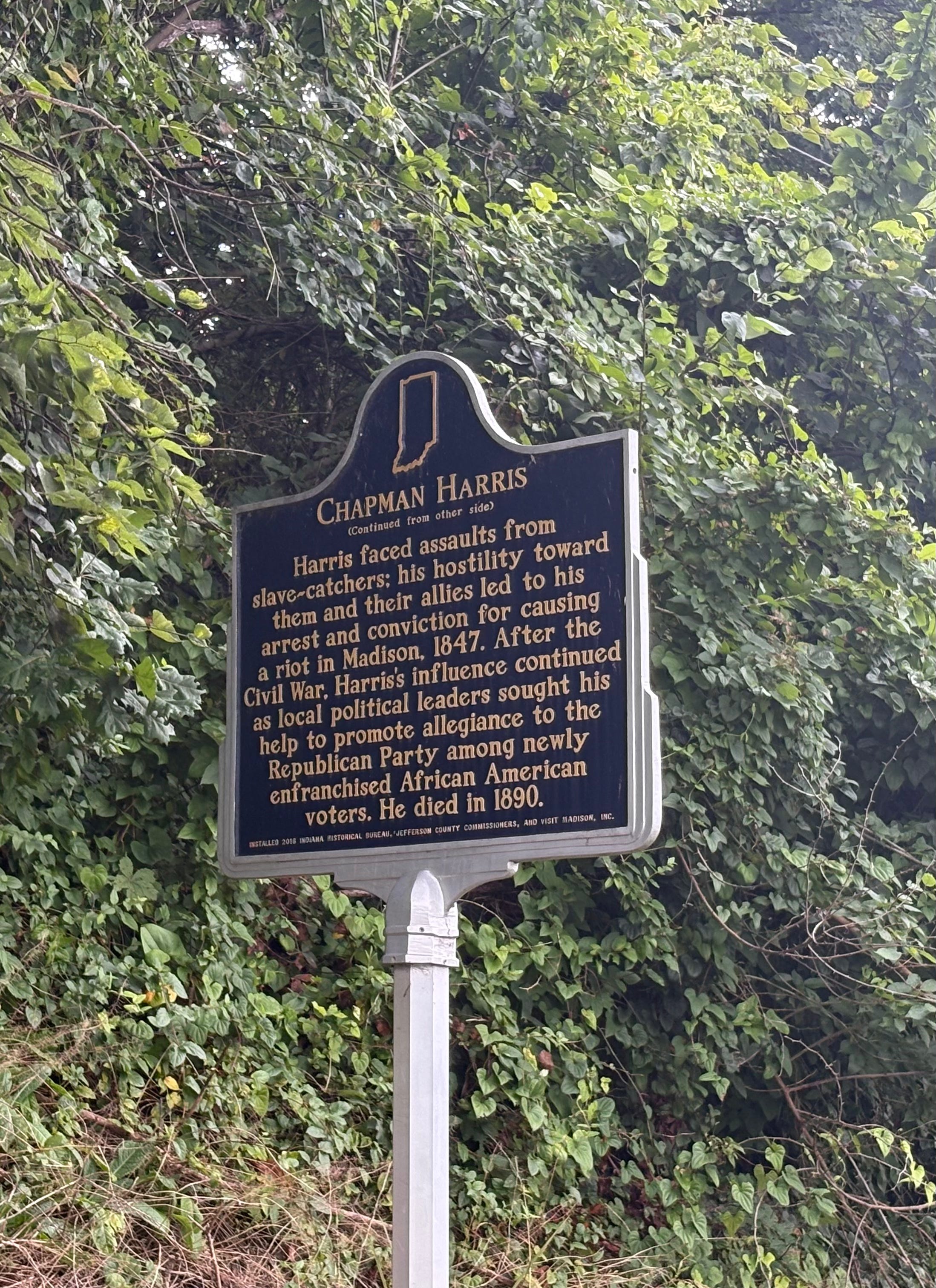
The story that interests me from among the many UGRR conductors in Madison is of Chapman Harris. The law of the time made enslaved status heritable through the mother, so being born to a free mother in Virginia made Harris free from birth.
In his thirties, he relocated to “free soil Indiana,” but was savvy enough to bring papers proving his legal status. Just as Ohio had done at statehood, Indiana enacted Black Laws regulating/constricting the lives of Black settlers, and without paperwork to prove their free status, Black settlers could be wrongly apprehended and sold into bondage across the river. Harris’s Virginia “free papers” are recorded in the Jefferson County Indiana Deed Record on March 8, 1843.2
Harris may have been a blacksmith, but he was most certainly a teamster, farmer, laborer, and Baptist preacher. He bought his wife’s freedom for $100 — a blacksmith’s full annual wage at the time — and married her in 1841. Patsey Ann Allen is listed as the sole owner of land they purchased in Madison in 1867 and 1870. It may have been a strategic move to protect it from being confiscated to pay legal fees and costs if Harris was convicted of illegal abolitionist activities. He came pretty close a few times.
I took a drive out to see the marker honoring his work near Eagle Hollow, where they lived. This is where his identity as a blacksmith may have originated because it was his practice to strike a large anvil that could be heard across the river to signal it was safe for fugitives to cross. Today that little stretch is a riverside campground and boat launch.
Madison’s abolitionist movement and UGRR wasn’t a clean story of white saviors and grateful fugitives. This great resistance movement required selfless action and interracial collaboration.
I took a twenty-minute drive from Madison to Lancaster Township, to visit the historic Eleutherian College, a school that accepted all people of all races in 1854. Yes, that meant boys and girls, Black and white, and all shades in between.
I felt guilty for parking on the grass beside the school even though that’s the designated parking area. One of the board members, Mark, assured me it was the same thing as parking for a county fair. After touring as many historical sites as I have, I quickly sized him up as a man who can rattle off names, dates, plat lines and geological formations without hesitation—the kind of person who would make a great documentary fact checker.
Inside, I met two other board members, including president Jan Vetrus, who led me through the building when another set of guests arrived to tour with Mark. Her interest seemed focused on the extraordinary restoration they’ve been pulling off on shoestring budgets.
Jan also explained the history of Baptists who formed Neil’s Creek Antislavery Society (the little community in which the college stands). We usually think of Quakers and Presbyterians making bold moves for civil liberties and Jan put it plainly: “the Baptists did a lot here and don’t get credit.”
Their society numbered about 80 member families, which is stunning for a rural Indiana township, but not surprising when you consider most of them came from New England and Pennsylvania—bastions of antislavery sentiment. Many of them were members of the Liberty Party, which started as an anti-slavery group in 1840 before joining other groups in 1848 to form the Free Soil Party. Eventually they joined anti-slavery Whigs and Democrats to help launch the Republican Party in 1854.
That migration pattern — New Englanders and Pennsylvanians carrying their antislavery convictions west with them — wasn't abstract for the families who settled around Eleutherian. Abolitionists—including the Tibbets family I mentioned earlier—moved west from Ohio to form Neil's Creek Anti-Slavery Baptist Church and to aid fugitives.
Virginia and the Carolinas sent settlers to southern Indiana too, when both states made manumission legally punishing. For example, North Carolina's 1830 law required a $1,000 bond per freed person, plus the freed person had to leave the state within 90 days. Whole congregations of Quakers picked up and left rather than choose between living with injustice and helping those at the short end of it. Indiana's own Quaker Yearly Meeting was founded in 1821 largely by these North Carolina transplants.
Jan had a good grasp of denominational leanings, telling me that some local Presbyterians barred church members from communion if they’d so much as befriended a slaveholder — proof that antislavery sentiment here wasn’t uniform, it was contested, factional, and denominational.
Living in the Ohio River borderlands required residents of all racial profiles to constantly recalibrate their speech and behavior to avoid meeting rough justice at the hands of neighbors. My childhood Ohio history books didn’t prepare me for the dissonance that settlers north of the river experienced living in a slavery-free state. The mind reels.
https://fordwebtech.com/tibbets-history/JohnTibbetsLetter.php
The 1816 Constitution clearly prohibited slavery and involuntary servitude but subsequent Black Laws said Blacks were not allowed to vote or to serve in the militia. They could not testify in court cases involving whites. Black children were not allowed to attend public schools. After 1831, Black settlers in Indiana were required to register with county authorities and to post a $500 bond as a guarantee of good behavior. Per https://www.in.gov/history/for-educators/download-issues-of-the-indiana-historian/indiana-emigrants-to-liberia/being-black-in-indiana/